Google Built a Monopoly on Search Defaults and Will Do It Again in AI
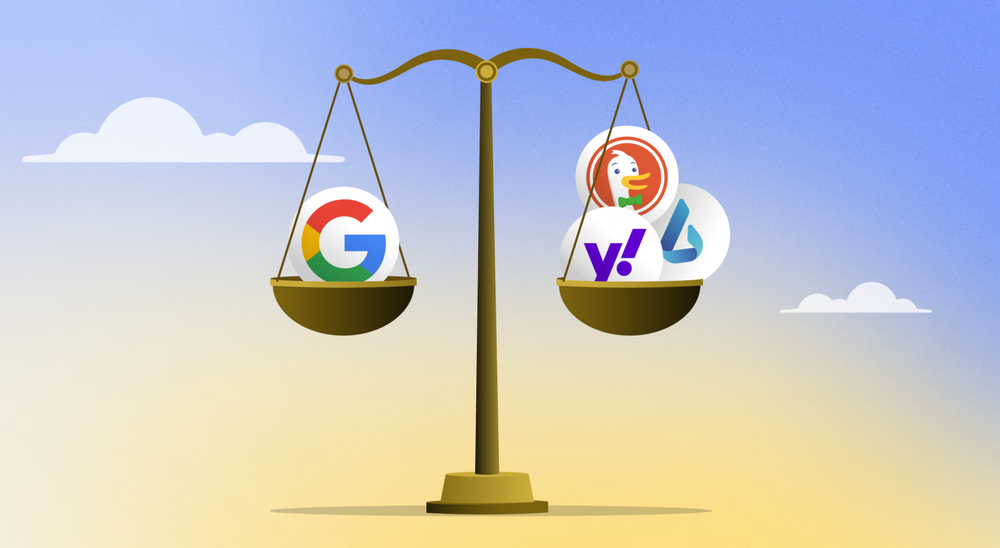
This week, DuckDuckGo is filing an amicus brief in the appeal of a federal court decision that Google unlawfully maintained a monopoly in the general search market in violation of the Sherman Antitrust Act. Google is asking the appeals court to throw that decision out, while the U.S. Department of Justice is asking for stronger remedies. DuckDuckGo’s brief shares our own experience and explains how Google shut out competition. More importantly, we describe how Google’s actions harmed not just competition but also undermined people’s ability to protect their privacy.
DuckDuckGo has spent nearly two decades building a differentiated search engine. It doesn’t track you; it doesn’t profile you; and it does protect your privacy. Nevertheless, many privacy-focused users continue to use Google for the sole reason that they use a device or browser that is contractually obligated to have Google preset as the default search engine.
Two years ago, a federal court finally agreed. That ruling should be upheld.
The record reveals the depths of Google’s monopoly
This trial established one simple fact: for most people, the competition for their search traffic is over before it begins. Google is the default search engine on roughly 70% of U.S. search access points, and the district court understood that being the out-of-the-box default is the most efficient way to distribute a search engine. Google doesn’t dispute this; it can’t.
Defaults win because people rarely change them. Most searches happen out of habit, and many people don't know there is a default, what it is, or that it can be changed. Completely ditching Google across a phone, tablet, and laptop requires detailed tutorials and hours of effort. Even DuckDuckGo's most devoted users, the ones who recommend us to friends, admit they haven't changed all their defaults. That’s not real consumer choice; it is a maze.
Google doesn’t compete; it obstructs
Google understood the power of defaults perfectly, and it spent enormous effort making sure no one could escape them.
First, it froze the search ecosystem with money, and lots of it. Google paid out billions of dollars, which was far more money than any rival could hope to match. As the Justice Department argues, those payments “made it economically irrational for distributors to switch default [search engines], thereby inducing exclusivity.” The district court agreed, finding it “financially infeasible” for Google's partners to switch away or seek greater flexibility. Time and again, browsers, device makers, and phone carriers concluded they couldn't afford to leave. So they didn’t.
Second, Google introduced choice friction to stymy users. Evidence was presented that Google tracks how many steps it takes to change defaults on different devices; it also discouraged Android manufacturers from giving users too much information about how to switch. While there is no technological reason a person shouldn’t be able to change their search engine in a single click, Google has ensured there’s no easy way to do just that.
This isn't a company that outcompeted its rivals. It simply paid to push everyone else out.
Google is running the same playbook in AI
Google is now doing to AI what it did to search. While the district court expressed hope that competition from generative AI might discipline Google and disrupt the market on its own, there is scant evidence of this.
Instead, it is pushing its own product through the platforms it already controls, whether people want it or not. It has wired its Gemini AI assistant directly into Chrome and moved to preload Gemini across the Android ecosystem, positioning it as the default AI assistant on the very devices at issue in this case. Capture the default, get in front of users before any rival can reach them, and turn placement into habit before anyone knows better.
What makes this so telling is that Google has forced AI on its users even when the product plainly wasn't ready. In May 2024, Google switched on AI for everyone, and it promptly started pulling “facts” from satire and troll posts. There was no easy way to turn it off. Google can shrug off a faillure like this in a way rivals cannot, using the profits from its search monopoly, to try and try again.
More than 95% of Americans still use a conventional search engine every month, a figure that barely moved despite AI-tool usage nearly quintupled. Nine in ten search referrals continue to come from Google, even including new generative AI rivals. That is what a monopoly looks like.
Affirm Google’s monopoly and end it
It doesn’t matter if people don’t want AI. It doesn’t matter if Google’s AI is wrong. Google can't be fired. No matter how badly the product performs, people stay put, because Google controls every access point where people want to search for information. That is the story of the search market and what may await AI, and it is why the court’s finding that this conduct is illegal monopolization must be upheld.